Chapter 5: Royal Air Force
After a couple of weeks, I got an invitation to go to a selection course at RAF Biggin Hill, which in itself was an achievement. I knew a guy at school who had been in the Air Cadets for years but was still turned down when he applied. I arrived at Biggin Hill and commenced a 2-day selection process which involved written, physical and leadership trials. The physical side consisted of half a day of coordination tests. One test was to sit in front of a machine with a rotating metal cylinder which was covered in a layer of paper, which had holes punched in it. The task was to guide a pointer across the rotating drum as it spun, while trying to follow a track of holes in the paper cylinder. It counted the number of electrical contacts you made between the pointer and the cylinder.
At this point about half the course were sent home, the rest of us stayed on the base in the evening but I cannot remember what we did. The next morning were the leadership tests. These were held in a hanger where the course was divided into teams of five or six. Then each member took turns to lead the team across different obstacle courses without touching the ground. Some of them were impossible, but they were judging your leadership abilities and not the successful completion of the obstacle. I succeeded in leading my team through my obstacle course with time to spare.
There was also a medical included in the two days. Here they measured my height, width, inside leg etc. presumably to check that I would fit in a cockpit. The highlight for me was a hearing test where I was invited into a room and sat on a chair facing a window. I had no idea and was not informed about what would happen next. Suddenly the nurse started tickling my ear and at the same time the doctor at the other end of the room started to say random words. I was in a completely surprised state, and when asked to repeat the words I have no idea where they came from but something in my brain had taken them in and remembered them. I was then turned around, and the other ear was tickled. This time I was ready, and the task was simple.
The final thing was an interview. I sat in front of two officers who asked about my interests and some general knowledge. They were most impressed with all the stuff I got involved with at school, such as the go-kart club and the hovercraft, which probably swung things in my favour.
In due course a letter arrived accepting me into the RAF as an officer cadet at RAF Henlow in Bedfordshire. This I think had a major influence on how much effort I put into my A-levels. I already had the career I wanted and did not need any extra qualifications.
I started in September, but unfortunately, I fairly soon began to regret it. I was only 18 and did not have the confidence or experience that was needed for the job. I should have applied a few years later, perhaps after university. Most of the other guys on the course were either just out of university or were non-commissioned officers looking for promotion. I fought through the course and kept my motivation up by keeping my eye on the future prospect of flying jets. I had some successes and some failures; however, I always had a problem with military life. I could not get with the saluting, the inspections, the marching and the shoe polishing. Another possible mistake I made was that I kept my car there, so almost every weekend I drove home to be waited on by my mother. I should have stayed at the base and got with the program.
As part of the course, there were a couple of leadership training trips in the woods at Ampthill and Ashridge nearby. There was also a 4-day camp in the Stamford Practical training area in Norfolk, which was cold and wet, but for some strange reason I quite enjoyed, except when I was leading. I was not good at leadership when I was tired, cold and hungry, and that is what I remember most about that trip. We did not have tents, instead we had to build our own shelters or use some old parachutes provided. There was one morning where I woke up under a parachute and during the night it had rained, and everyone was lying in an inch or two of water. Our food was usually hidden at some location in the countryside and our last mission of the day was to try to find it in the dark. On at least one occasion we failed and had to go hungry.
After Norfolk, I was encouraged when I got the opportunity of flying in a Jet Provost, which was a single engine training jet of the 1970s. I took the controls a couple of times and really enjoyed it. This highlight however was not enough to compensate for the whole military thing. One day my flight commander called me in for a progress interview, there was no hiding anything from these guys. All my misgivings came out, and after some traumatic soul searching, I asked to leave. At the start of the course, I signed a document to serve in whatever capacity for 16 years, but in reality, they were never going to enforce that, so, after 4 months I was out. I had to hand everything back, even the boots that I had worn in after 4 months of marching and had grown quite attached to. All I have left from the whole experience is a couple of photos and my discharge papers. I was now unemployed.
I cannot remember any great celebration or commiseration when I turned up back home and announced that I had left the RAF. I think my mum said something like "You are better off out of all that.", but that was it. I settled back into my bed in the shared room with my brother Steve and just carried on at home as if nothing had happened.
I was a bit lost at this point. All my focus had been on the RAF career, and I had no other options lined up. I did not want to work as a plumber for my dad, I did not want to go to university and study Physics, and I thought I had missed the opportunity to go to Central School of Art and Design, although if I had tried, I may have got in the following year. I had also moved on from school and most of the people I had known there, so there were only a small handful of them that I could call up and go for a drink. It took a while to get used to my new situation, but it helped a lot that I was happy in my own skin, in that I did not desperately need people around me. I was not too upset about the RAF, it was just something that happened and it did knock back my confidence a large notch and from which I knew that I must move on. So, the first thing I needed to do was get a job.
After about a week back home, I went down the job centre and looked for something, remember that there wasn't any internet yet, so job finder sites were still in the future. I rather thought I wanted a design or draughtsman role. Incidentally, a couple of weeks after I came back home the soles of my feet started dropping off in lumps. I thought I had leprosy or something. In fact, it was an indication of how much hard skin had built up on my feet because of all the marching and yomping we did in the RAF.
My first interview was at a company called Cartners, who were a contract design agency, close to home in Kenton. At the interview, I was put in front of a drawing board and asked to write some drawing notes freehand. This is when I found that my freehand writing was still appalling. I could not keep the bottom or top lines straight. What made it worse was that sweat began pouring from my hands when I realised that I was not doing very well. I didn't get the job. I learnt later that Cartners was a bit of a sweatshop, so that was a lucky escape.
Somehow, and it may have been on one of the trips to the job centre, I spotted a job for a junior draftsman to work for an industrial design company on Harrow-on-the-hill. I can do that, I thought, and after an interview, got the job.
RAF
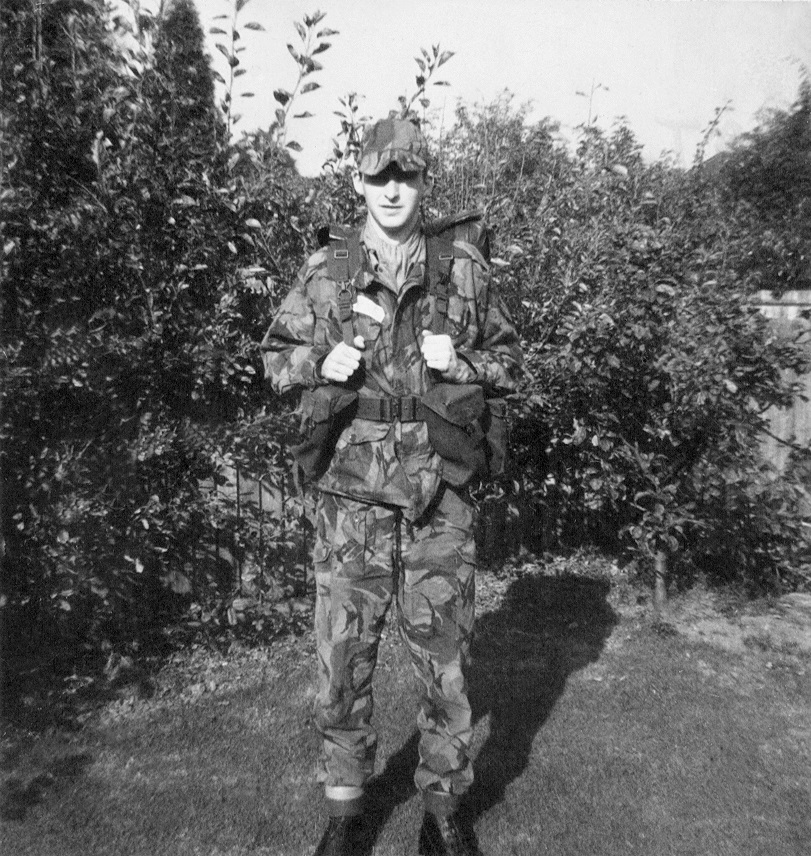
Me in my combats
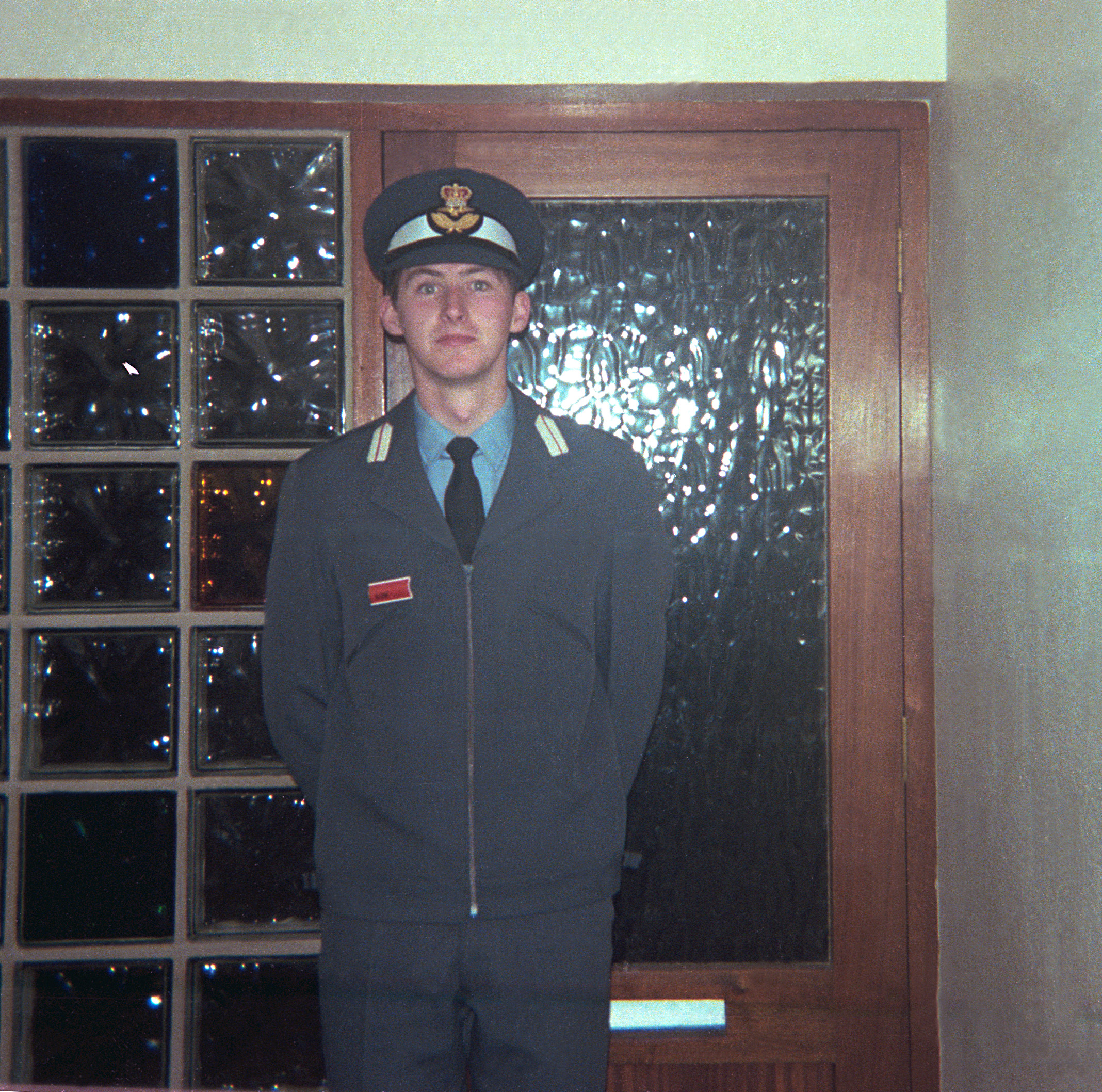
In cadets uniform