
Chapter 8: Racal BCC.
The design work was done in a building in Stonefield Way in Ruislip, which was the original BCC building. In Wembley, in the shadow of the old Wembley stadium was the manufacturing building where the radios were assembled and tested.
I arrived while they were developing their next generation of radios, called Jaguar. These were frequency hopping, so were very difficult to intercept or jam. This company was on a different scale to Kirkbrides' as there were thirty or forty drawing boards in the office as well as work desks for the electrical engineers.
Racal were kind enough to let me continue the HNC course that I started at Kirkbrides, so for the first year and a bit I was working four-day weeks. Incidentally, when I finished the course in 1982, I had the best results in the final exams from all HNC courses at Harrow technical College and I was invited to an award ceremony in London where I had to walk on stage and receive a certificate from the Duke of Kent. This was all very surreal to me and the memories are a bit foggy, but I do remember that my parents and I drove up to Friends House in Euston, and I recall being stage managed by ushers so that I walked up to the platform at the correct time to shake the Duke's hand. My certificate has been sadly lost over the years.
After starting at Racal, I initially did a number of weeks being introduced to the company by working in various departments. I remember visiting the quality, measurement and test departments, which were all in Wembley.
The Wembley site was a dark, hot maze of a building. The top floor was management and offices, of course, which I cannot remember ever visiting, then there was the assembly area, which was staffed with Asian women mostly. I think I spent some time there.
I did a few days in a department called burn-in. This was deep in the bowels of the building. Burn-in was where the finished radios were placed in a large walk-in oven, powered up, and then the temperature raised and lowered. The idea was to force any failures before they happened in the field. The ovens made the department a noisy and stiflingly hot place to be, which always smelled of hot metal. There were a couple of old Asian guys who worked in this dungeon. Their job was to load the ovens, and then sit around for 48 hours until the radios were cooked. One of these guys claimed to be a palm reader and he said that he could see people's futures in the lines on their hands and offered to read mine. I reluctantly agreed because at the time I had a couple of warts on the palm of my left hand. He took a long look and said that I would always earn good money, but I would never be really rich. How right he was.
Another memorable event occurred in one of the offices. I was seated with a couple of guys when a few more came in, laughing and joking. Suddenly one of them struck one of the seated guys hard with a heavy book, laughing as he did it. The guy who was struck just continued to sit there and look away. This shocked me at the time and still does today. This was the only instance of physical workplace bullying I witnessed.
Working at Wembley was an eye opener for other reasons. There was a culture of mistrust between the management and the shop floor. The factory people regarded the management as aloof and remote. From the management perspective the mistrust was based on the high frequency of thefts and damage that they saw, and there were also cultural differences which caused friction. The toilets were often a problem area at BCC, they had to put up notices in all the cubicles to insist that squatting on top of the toilet was unacceptable since they often missed and splashed the floor and the walls. There seemed to be a couple of people employed just to clean up the mess that was often found. I used the toilets a few times and noticed that the cleaning was not always thorough.
After doing the rounds in Wembley, which took about three months, I eventually ended up back in Ruislip, but before I could start my real job, I had to do some time in two more departments. My first stop was in the workshop. There was no 3D CAD yet, and no 3D printing, so all prototypes were machined from solid aluminium or plastic using 2D drawings by a team of very skilled machinists and toolmakers in the workshop. My time there was spent doing simple bending and drilling tasks. I was not let loose on any of the milling machines, but I did have a go at a lathe to make screw threads. The banter was always good in the workshop and no subject was off-limits.
I could see the skill that these guys had, so I assumed they were well paid, however one of the guys announced one day that he was leaving. He had been offered a job in BT doing wiring in those green boxed that you occasionally see by the roadside. The money for the new job was much more than he was on as a toolmaker and required virtually no skill. I thought at the time that it was unfair that the flair and experience it took to be a toolmaker was not properly appreciated.
My final stop before starting in the design office was in the change department. This department had its own little area at the back of the building, which is where any changes to products are documented and implemented on the drawings as well as in the item and drawing lists. Everything was manual remember, so a drawing change involved getting the drawing from a plan chest somewhere, then rubbing out and inking in the new information. The parts lists were also manual. They were on A4 size plastic film with a pre-printed format. Here again there was rubbing out and inking in involved in the change. Before changing anything though, the drawings and documents needed to be printed and marked up with red ink. Along with a change request form, which was handwritten, these went to a change control meeting for approval.
I was happy to find out that BCC used ink for their drawings rather than pencil. They also made drawing notes using stencils, so my appalling freehand writing was not exposed.
The drawing boards in the change department, as well as the design department were staffed with a mixture of permanent and contract staff. The contractors seem to have been there for quite a few years and were now part of the furniture. Even then, I was not attracted to the life of a contractor. They earned more money, but they could be sacked in an instant and would then be without wages until they could find another contract. I liked stability then and still do today.
About halfway through my stay in the change department I was given the job of changing a resistor that was used on many different products. Changes at this bottom level of a product meant that everything above it must be changed as well, so I ended up with over one hundred documents to change, and because some of them were already on change, I could not complete my job until the documents became available. I never finished that task, and it had to be sorted out after I left to work in design.
I will take a short detour here so that I can explain how prints were created before photocopiers and large format printers. In the early days if you needed a print of a drawing you had to get the master drawing and use the diazo printing machine. The diazo machine used ultraviolet light passing through the master film drawing onto a sensitized paper sheet. The sheet is then developed using ammonia hydroxide. This is all done in the one machine. The finished print was called a whiteprint as opposed to a blueprint, which was a different process. The strong smell of ammonia was a signature of print rooms in those days, and the girls who worked in them.
In later years, they changed to a microfiche system. This is where all the drawings are photographed on an enormous flatbed light box with a gantry-mounted camera above the centre. The negative was then embedded in a card carrier. To get a print you needed to find the microfiche card and use a special printer which used the negative to produce an enlarged print. Much less smelly.
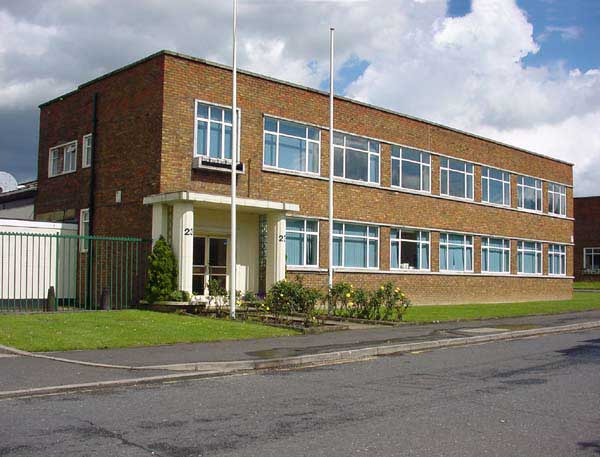
Racal BCC Ruislip. Now demolished.
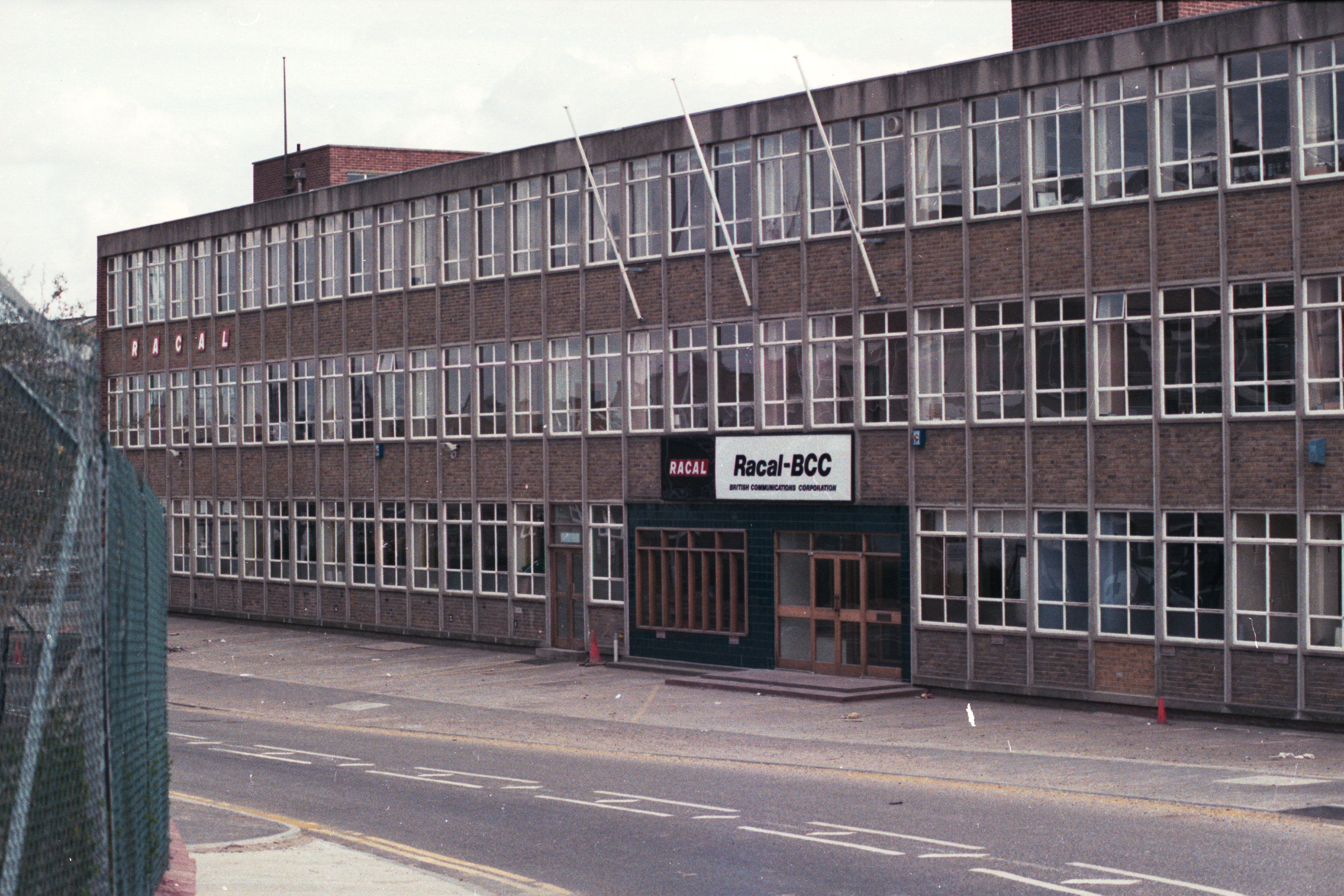
Racal BCC Wembley. Now demolished.
In charge of the design department was Geoff Watson, a tall, slim moustachioed man in his 50s. The guy in charge of the whole office was Peter Paine's dad, who was chubby and red-faced, but I cannot remember his first name. He retired soon after my arrival and was replaced by someone whose name also escapes me. Over the space of a few years, he became an alcoholic. He would often turn up late for work and smelled strongly of alcohol. He became less and less useful but was never sacked.
I can remember spending my days in front of a drawing board working on various things. Strangely I cannot remember many specific jobs, they all just blurred together. I do remember some of the people though.
In my travels through the various departments, I had come across a few apprentices doing the same rounds. They however stayed much longer than I did in each area before specialising. Most of them it seems opted to work in design at the end of their training, so they also started to trickle into the design department.
Most of the names of people at BCC have been lost to me, but notable ones I do remember are, Cass Candy, Tony Bates, Tim Snell and Mike Sparks. I got quite friendly with Cass, Tony and Tim. Mike Sparks was one of the contractors who sat near to me and was always a source of many boys' stories to amuse us. From the group of ex-apprentices, I remember Phil Evans best. The apprentices were all from the same mould, white socks and logos on their clothes. We christened them beer-boys, nowadays they would be called roadmen.
There was quite a good social scene in the office. The beer-boys were always going down the pub at lunchtimes, and I often went with them on Fridays and managed two, and sometimes three pints before driving back to work. Needless to say, the afternoons were quite foggy. There are many faces and voices whose names I have forgotten, but I few of the ones I do remember are in the following sections.
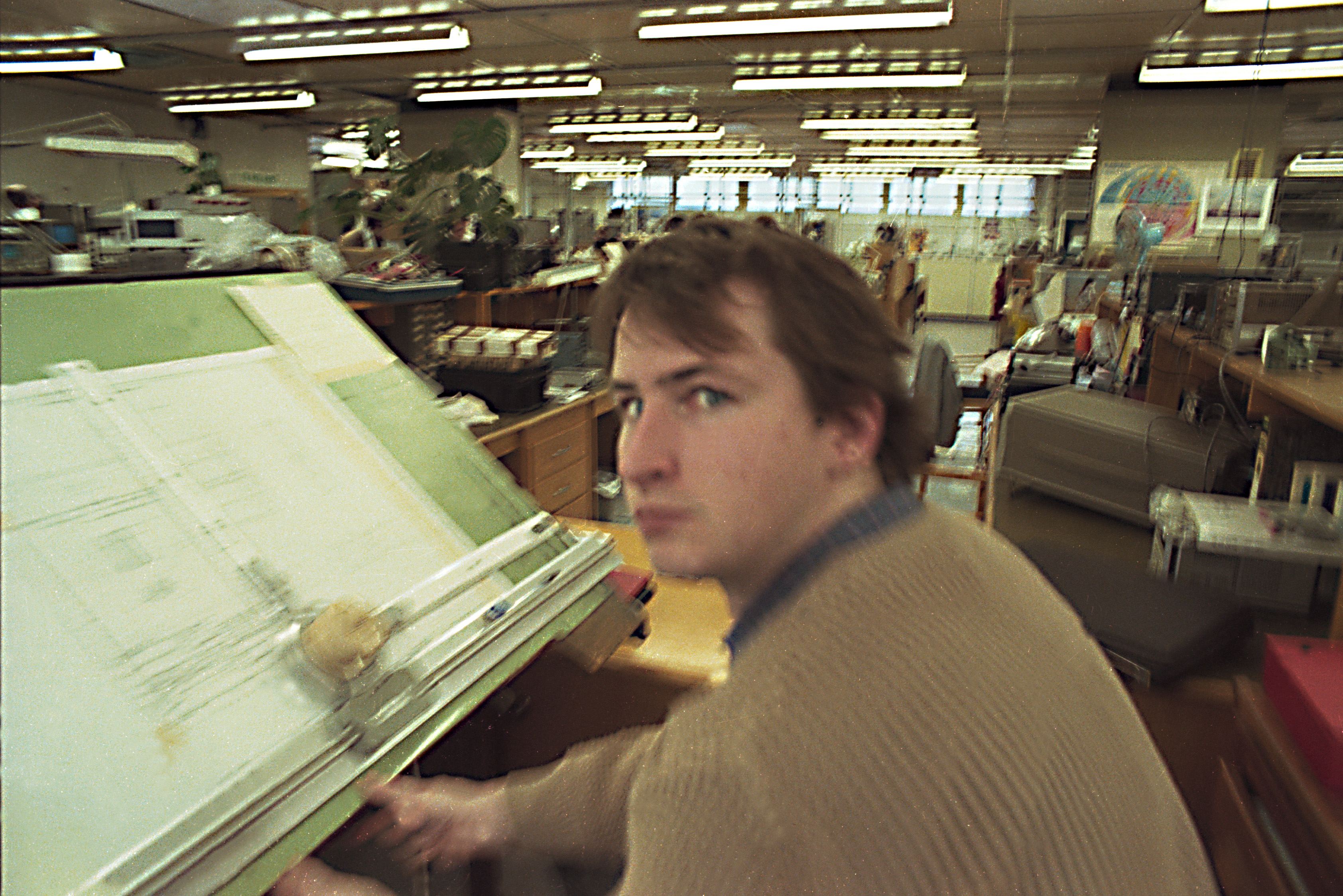
Me at my drawing board
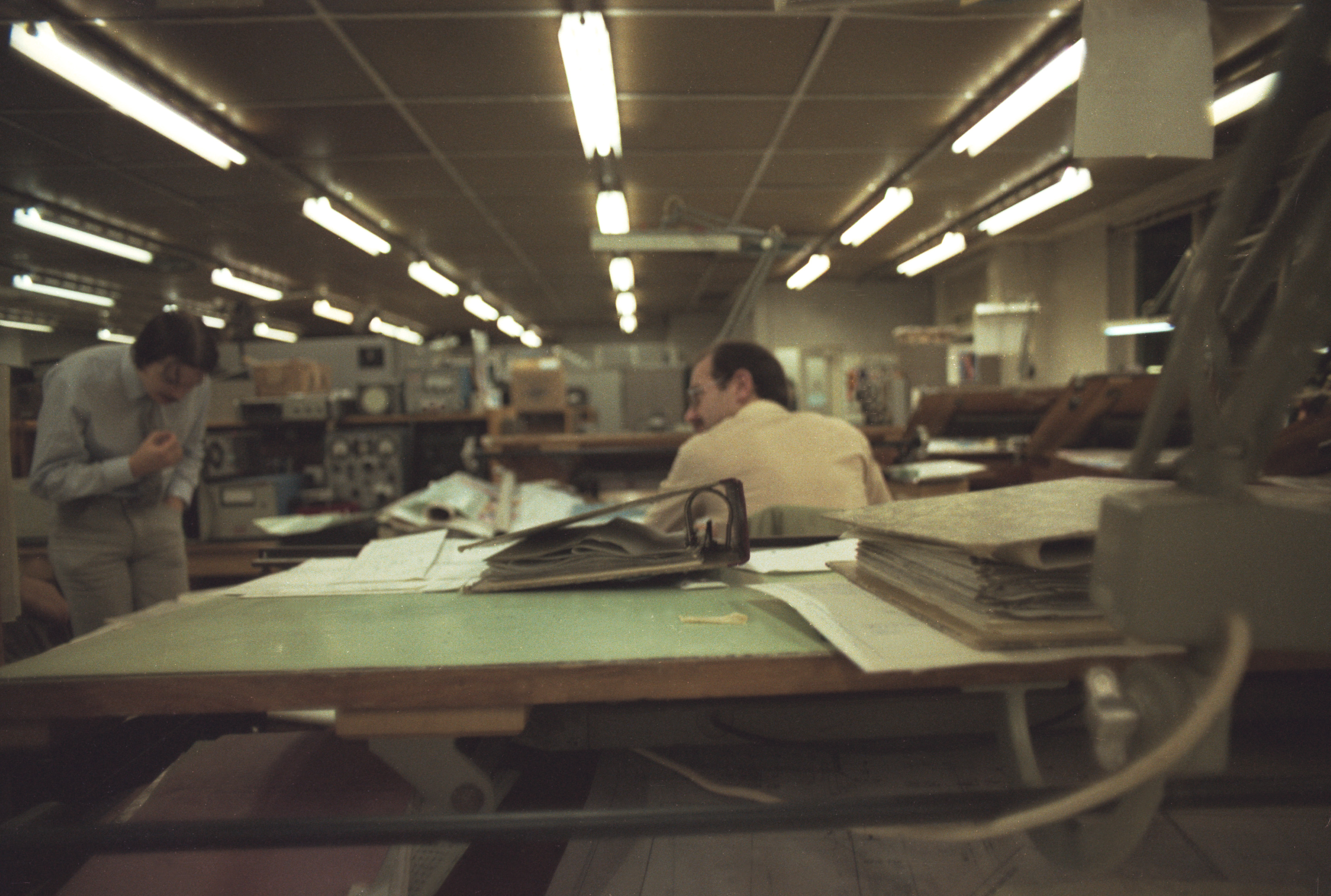
Racal design office
Cass was a short, slightly balding guy in his late twenties with a Freddy Mercury moustache. He always had a big smile on his face and was a great source of office jokes. At Racal, he was a printed circuit board (PCB) designer. His work started with a circuit diagram from an electronics engineer. Using this, he produced the design and artworks needed to make the board. This commenced at the sketch stage using green and red pencils to draw the connecting tracks between the legs of the components on a sheet of film. The colours signified which side of the board the tracks were on. Multi-layer boards were very rare then, because surface mounted components were also rare. When the sketch is approved, the design is then laid out onto film, usually twice full size, using black crepe tape and a scalpel. Sticky black dots are used for the component pads and reels of different width tape are used to make the tracks between them. Some of these layouts were works of art in their own right. The finished layouts were then used to make the photo-tools to manufacture the PCBs.
Cass took up PCB design after he dropped out of studying engineering at university. His main interest in life was vintage cars. He had a couple of 1930s Austins which he kept in an enormous garage next to his house. Sometimes the cars were used in film or TV work, with him as the driver of course. He was single but was always on the lookout to change that. The name Cass was shorthand for Calvin, which was given to him by his highly religious parents who divorced when he was young. He was out of communication with both of them.
I got on well with Cass, and even went on a few holidays with him. Our friendship had a hiccup when I stole his girlfriend, but more about Helen Strojek later. Cass eventually found his woman, and very nice she was too. Ironically, he stole her from another friend of his. We kept in touch and did a couple of skiing holidays even after I had left Racal. One day though, out of the blue, Cass announced that he had become a Jehovah's Witness. He started quoting the bible and saying things like "The Jews are guilty of killing Jesus and should be punished." He had also been told by the witnesses that he could not work for a company that made products for the military. I could not convince him that this was all a bad idea, and we lost touch.
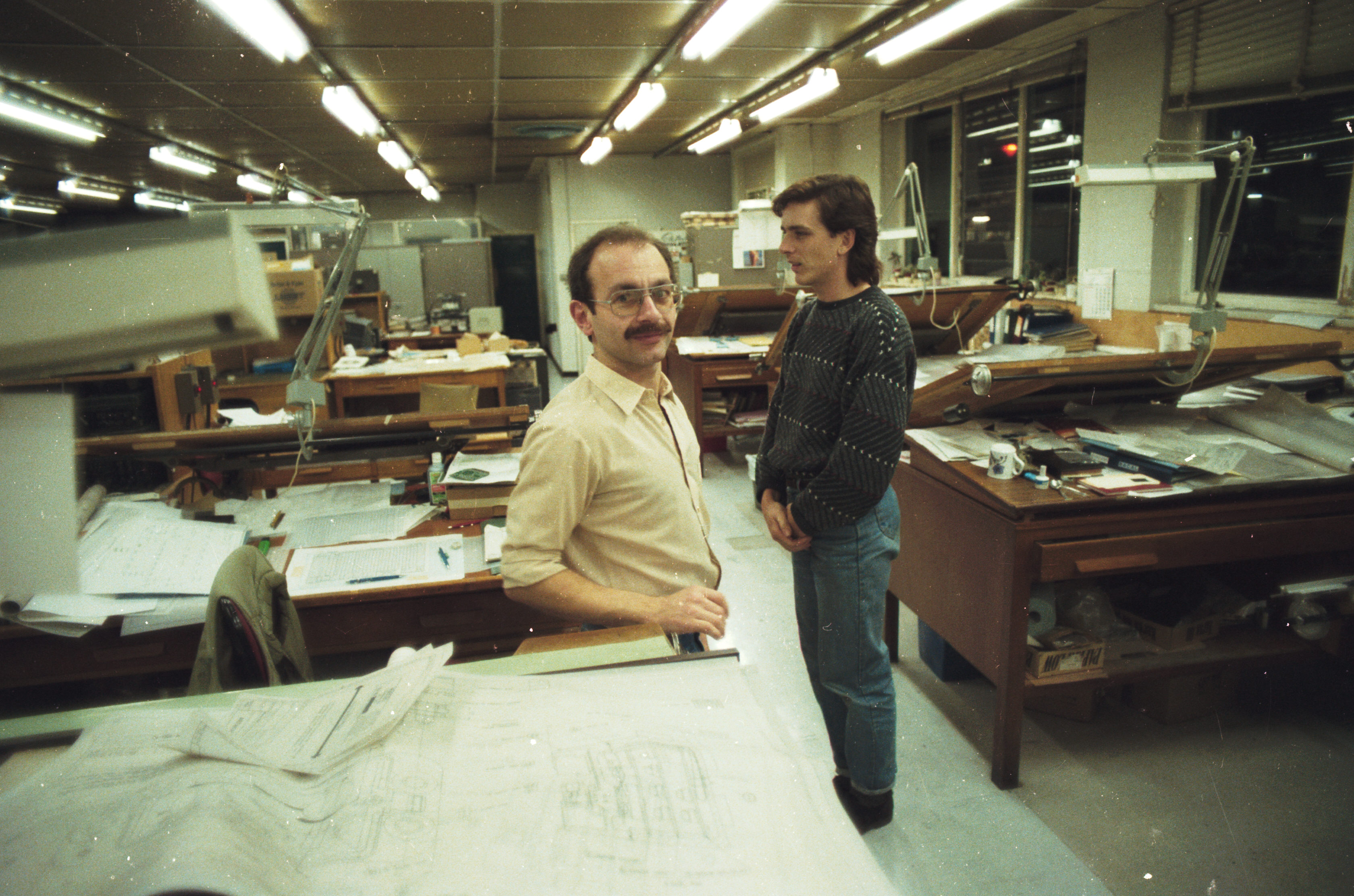
Cass on the Left, Tony on the right
Known universally as Master Bates, Tony was a mechanical designer just like me. He had a Chinese girlfriend, which was very exotic at the time, and often went clubbing in London and had a Brian Ferry hairstyle to match his image. I was never into clubbing, but we used to have a drink or two now and then and I even stayed in his flat in South Harrow once. While I was working at BCC, we often went out places together, but as with most people, I completely lost touch after I left.
The day Tim arrived in the office everybody noticed. He was pretty much bald, just a light stubble all over. The story was that after completing his degree, he and a few mates went on holiday to the south of France and in a drunken moment they decided to shave all their hair off. That was quite a celebration, but then Tim had just got a first-class degree in Engineering Science from the University of Oxford. Tim joined as an electronics engineer at BCC. I got to know him through Tony because they both had an interest in football. Tim became probably my best friend at BCC, and we remained friends for a number of years after.
Tim and I often went for a drink and a curry at weekends. He was living in a shared house in Ruislip Manor, which was sort of extending his student days. Our ambition with curries was to work up towards the hottest type, a phal. I never made it, but Tim had one once and regretted it. It was through Tim that I started playing a little golf. He decided it was a good idea to go to the local municipal golf course on a Friday afternoon since we finished early on a Friday. There were a couple of other semi-keen golfers at work who accompanied us, and it was always a very pleasant evening. We then proceeded to the pub and a curry house. This new golf skill came in handy in later years when I took up golf again with another group of friends. While he was away one weekend, I actually borrowed his digs in Ruislip to take a girl I had met whilst visiting some skydiving friends in Hitchin. It was a great weekend, but I cannot remember her name anymore. More about my skydiving adventures later.
It was when we were in the pub one day and we were talking about universities and the reasons why I had not gone, when I just mentioned that I knew somebody from my school who went to Oxford, and when I said his name was Cornelius Bohane, well Tim nearly choked on his pint. "What!" he spluttered, and I had to repeat the name. Apparently, Tim knew him well. He was the captain of the football team at Oxford University. Tim said that he was not actually a friend, but his reputation was legendary (for reasons I have forgotten). The point is that it is a small world. If you remember, I knew 'Corny' from school when he filched a girl that I had my eye on. Tim was amused by this story and revealed that Corny got Tracy pregnant while he was at Oxford and had to rapidly marry her. I looked him up in later years and in 2024 they are still married and live in Beaconsfield.
Tim met his future wife when he went to watch the Oxford-Cambridge boat race in London one year. They met, and talked, and he invited her to go to Henley Regatta a couple of weeks later and she accepted. To cut a long story short they hitched up and moved in together in a flat above some shops. Tim and Cathy's relationship was fiery at times. One day when I went to visit them in their flat, I could hear them arguing as I approached in the street outside. I waited for a lull before ringing the doorbell. After a couple of years, Tim got itchy feet and applied for a job more in line with his abilities and education. He interviewed for a role as an examiner at the European Patents Office in The Hague. Albert Einstein was a patent examiner when he wrote his theories of relativity. The interview was in French and German as well as English. He got the job, and I promised to come and visit.
I did visit a couple of times by taking the ferry from Harwich. I quite enjoyed that journey. The flat they had in The Hague was fantastic, all high ceilings and big windows. A few years later when I was working in Denmark, I drove down and visited them for a party. A couple of years later I went to their wedding, about which I remember absolutely nothing.
Due to geography and the fact that I really did not really like Cathy because she was the fiery one in the relationship, we lost touch. My last contact was when I got a Christmas card after they moved to the Patent office in Munich.
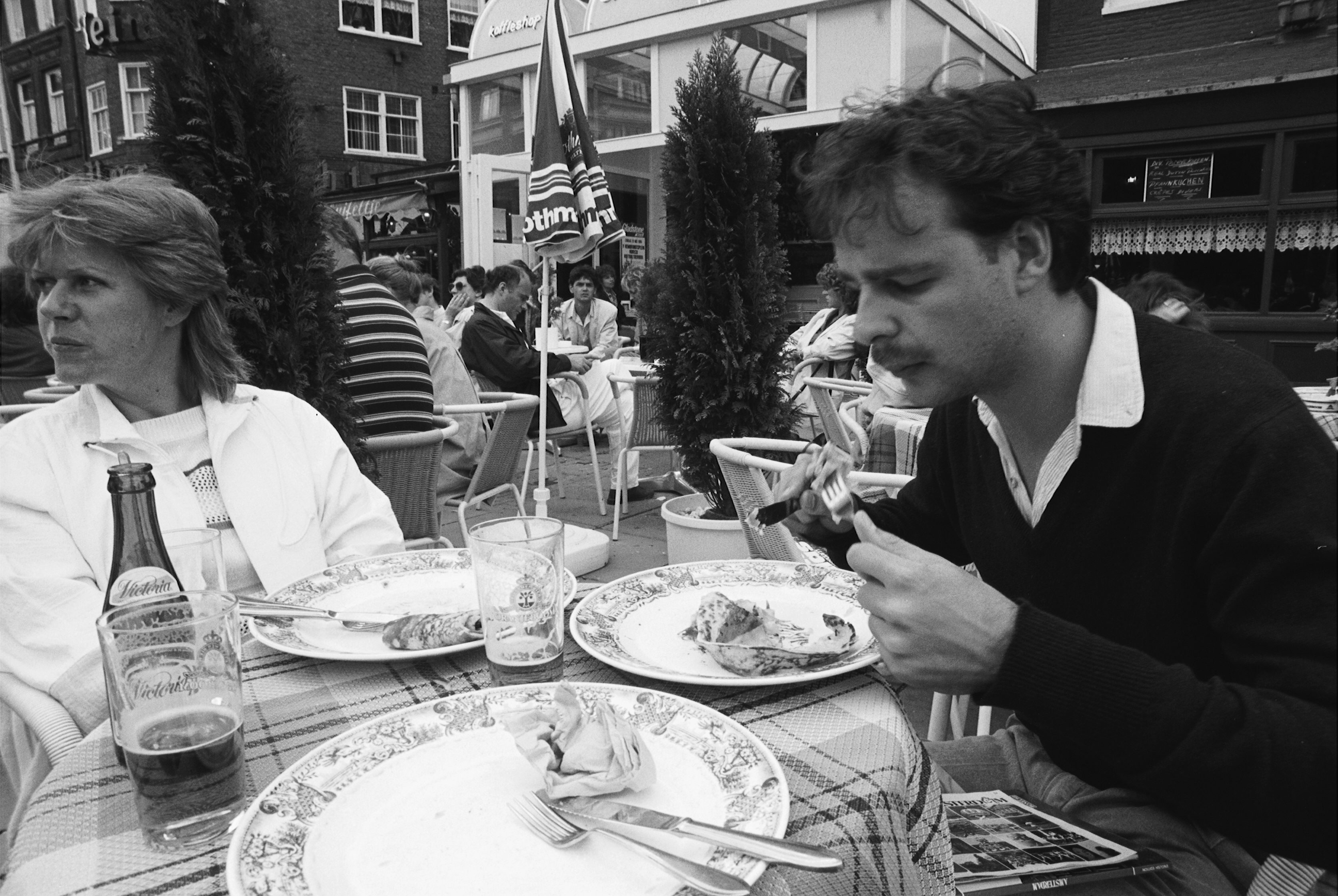
Kathy and Tim in The Hague
Helen was the design office secretary. She had her own little cubicle away from all us distractions. She was slim, quite small in height but very well endowed out front. She was pleasant enough but quiet and shy. I ignored her for the first couple of years due to how aloof she seemed. At some point Cass decided to make a move and started seeing her outside work. They used to go to the cinema, meals and other such outings. Cass was always complaining to me that the relationship was not progressing to the physical stage, in other words, no sex. It reached a point where he said he had given up on her and the relationship regressed back to a friendship, but the truth was that he still had a flame burning for her.
It all started for me at the annual company barbeque, which was held at night in a clearing in some local woods. I found myself next to Helen and contact was made. Well, she clung to me for the rest of the evening, and we went home together. The physical side of the relationship started immediately. The news from the barbeque soon got back to Cass and he said to me "I hear you and Helen have got together", or something like that, "Yes." I replied. "Well, you'll soon get bored when you find out that she doesn't do the business." he said, and I replied, "But she does Cass, she does." That is when I realised that Cass had not really given up on her. He was so upset that he took the rest of the day off. I just went down the pub as usual since it was Friday.
Helen did not last more than a few weeks. As with most relationships that start physically, the reality that we were mismatched gradually became apparent. We still communicated in the office but only concerning work issues. Cass never renewed his quest, maybe he had finally got the message. He also soon forgave me, and we were mates again. After me, another guy in the office began to chase Helen. I heard that he ended up with the same arrangement as Cass did.Helen was the design office secretary. She had her own little cubicle away from all us distractions. She was slim, quite small in height but very well endowed out front. She was pleasant enough but quiet and shy. I ignored her for the first couple of years due to how aloof she seemed. At some point Cass decided to make a move and started seeing her outside work. They used to go to the cinema, meals and other such outings. Cass was always complaining to me that the relationship was not progressing to the physical stage, in other words, no sex. It reached a point where he said he had given up on her and the relationship regressed back to a friendship, but the truth was that he still had a flame burning for her.
Helen did not last more than a few weeks. As with most relationships that start physically, the reality that we were mismatched gradually became apparent. We still communicated in the office but only concerning work issues. Cass never renewed his quest, maybe he had finally got the message. He also soon forgave me, and we were mates again. After me, another guy in the office began to chase Helen. I heard that he ended up with the same arrangement as Cass did.
We did have a computer system in the building, but it was used by the accounting team to do the books. The machine was an enormous DEC PDP15 and had its own air-conditioned room. One day though, possibly in 1980, screens with keyboards appeared around the design office. I was told they were VT100 terminals linked to the new mainframe computer. The ancient PDP15 had been replaced by a new VAX 11/750. Incidentally, the IT manager bought the old PDP15 and reclaimed quite a large amount of gold from the PCBs. Everyone had a login, which could be used on the terminals. There was no mouse, just a keyboard and a text screen. To us, this was incredible technology. We could create programs using the BASIC programming language and write text documents, but the internet and emails did not exist yet. The most popular thing on the terminals was not work related, it was the first version of dungeons and dragons which was played entirely in text on the keyboard. I spent hours in the evening navigating the dungeon world one room at a time. 'You are on a twisty winding road' is a phrase that will remain with me forever. I was once reported by a manager for playing games in overtime. He was sent packing when told that I did not claim overtime.
It was on this system that I did my first and only computer hack. Using BASIC, I wrote a program that mimicked the VT100 login screen. The unsuspecting victim would use this screen to try to log into the system, but what happens is the program saves his login and password, posts a message saying that the password is wrong, and then it resets the screen to the normal login. The user can then login as usual, just thinking that he typed the password wrong the first time. Using this hack, I had access to several people's personal files. Actually, it was mostly boring, except I did find someone whose password was the name of one of the girls in the office.
I think from this point, which is about 1980, the computer age really started. At work we got a PCB design system from Racal Redac. This is obviously an internal purchase within Racal, so no doubt it was cheap. For some reason I was one of the operators, Tony Bates was the other one. I had never designed a PCB before, but I did have a bit of computer experience. Cass was not involved because he was a lowly contractor.
The machine was called a Redac Maxi system. It ran on a DEC PDP11/34 computer, which was the size of a three-drawer filing cabinet. As well as the computer, you needed a hard drive cabinet, a plotter and a workstation. Each user had their own hard drive, which had to be loaded before booting the machine. If you wanted to change user, then you must shut everything down, swap the disks and boot it up again. Each disk was the size of a car tyre and had a capacity of just 10 megabytes. The great thing about using the system was that it was housed in the only air-conditioned office in the building, so in the heat of summer we got a lot of visitors.
Around this time, I got a bit of a reputation as a competent computer programmer. I put together a few data manipulation routines using BASIC. These routines took print files from the CAD system and manipulated them to create drawings that resembled our existing drawing standard. Tim Snell was very complimentary, thought I was very clever, and should change career.
One day a new computer appeared on a table in the middle of the office. It had IBM written on it. This was the first PC I had ever seen. I had a couple of goes, but these were the days before Windows and before mice. It was good for a couple of engineering tasks, but I mostly remember it for the snooker game. This was a colour 3D graphical game, again another first.
If I wasn't doing PCB design on the Maxi, I was back on the drawing board with my ink and rubbers.
On the back of all this exciting tech arriving, I saw a homemade computer kit in a magazine and decided to get one. This was the Powertran Cortex, which was a 16-bit colour computer. I had no disks, so to save and load anything you had to use a cassette tape player. I built it and got it working, much to the surprise of the guys in the office. I remember sitting in front of this thing for hours writing programs and exploring machine code. Eventually I bought a floppy disk drive and wrote my own disk operating system, which I called JDOS. With this, I could load and save files to floppy disk. I could list the files and do all the usual stuff like copy, delete, rename etc. All of which was written in TMS9995 machine code. Looking back, I realise that this was an amazing achievement. I once printed out all the code on a fan-fold printer at work. The pile of paper was about 3 inches thick. I lost interest at some point and stupidly threw it out during a house move.
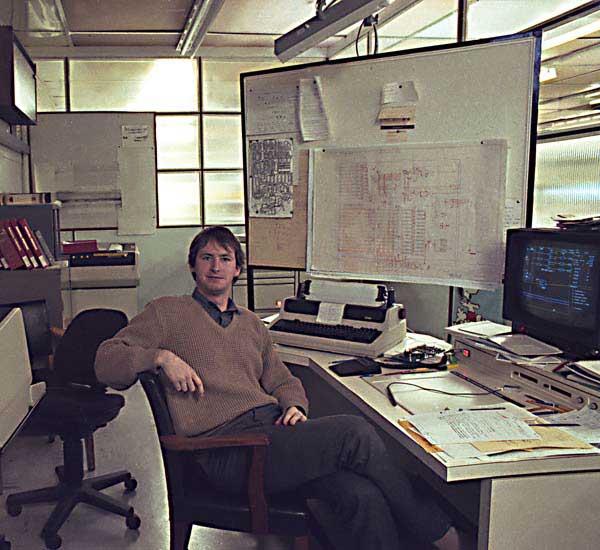
Me at the Maxi CAD terminal
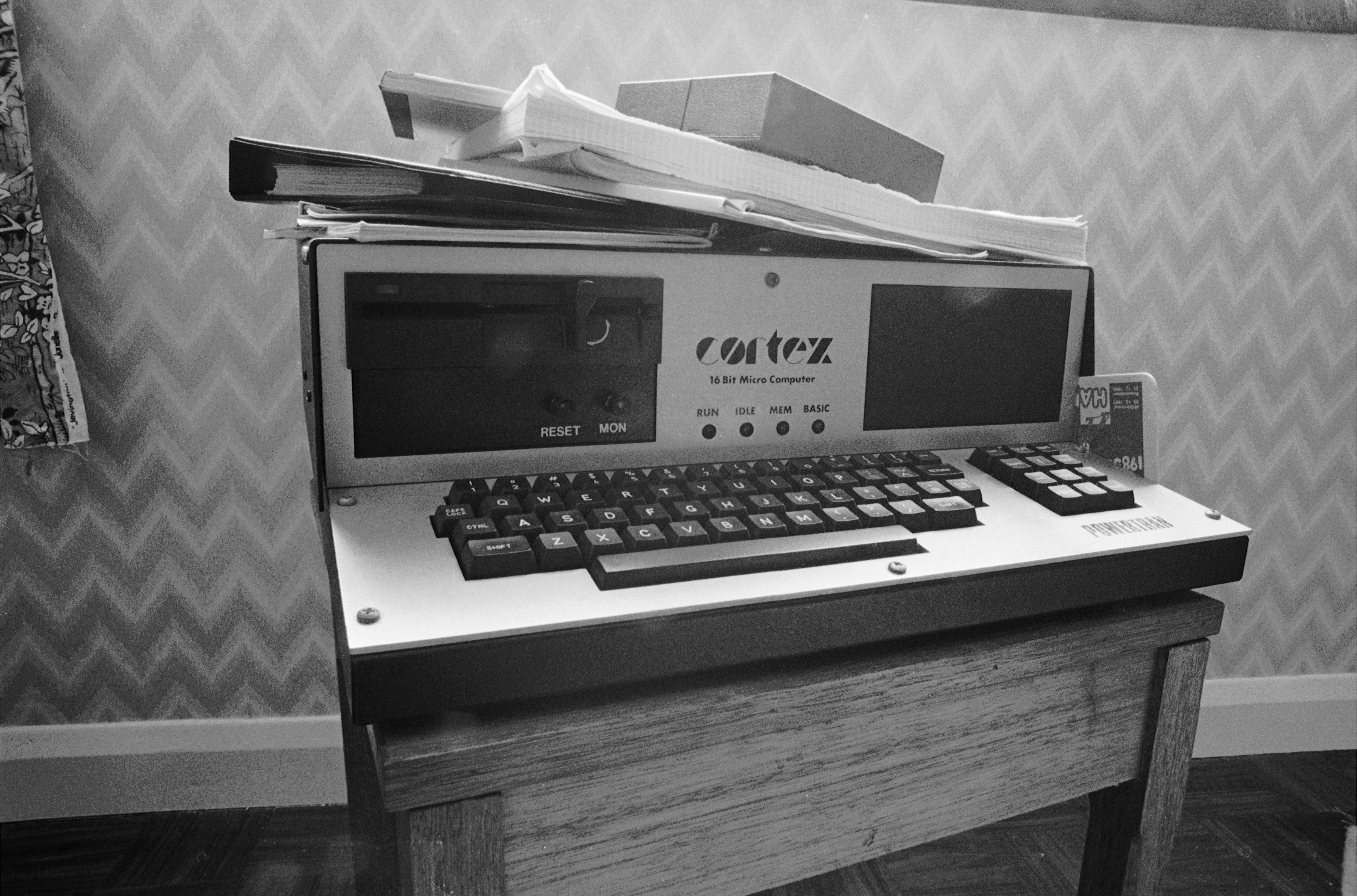
Powertran Cortex